Winner of ACM-MM 2026 Challenge
Ranked first for the ACM MM 2026 Explainable Deepfake Detection Challenge.
ACM-MM 2026 Accepted · Explainable Deepfake Detection
1 Wangxuan Institute of Computer Technology, Peking University
Abstract
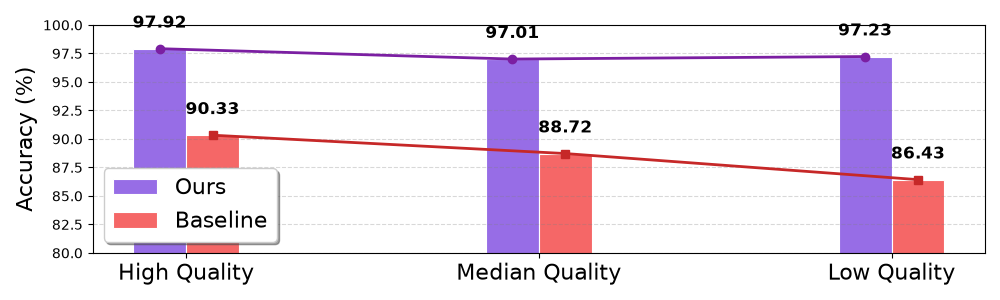
This paper introduces a novel framework designed to enhance both the detection robustness and the explanation faithfulness of deepfake detection systems. Existing explainable deepfake detection methods often suffer from two critical vulnerabilities: sensitivity to image quality degradations, which causes prediction instability, and a lack of evidence accuracy verification, leading to explanations that omit key evidence or include hallucinated details.
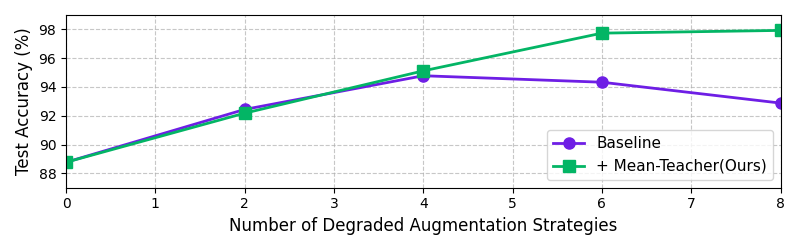
To solve this, our framework jointly addresses these challenges using two main components: Feature-Robust Augmentation, which employs a degradation-aware augmentation pipeline with a mean-teacher architecture and supervised contrastive loss to prevent intra-instance feature drift; and Evidence-Grounded Explanation Optimization, which constructs chosen-rejected explanation pairs and uses Direct Preference Optimization (DPO) to prioritize genuine manipulation evidence over superficial reasoning patterns.
Through these methods, our framework delivers a detector that is not only accurate across diverse quality conditions but also transparent in its decision-making, achieving state-of-the-art overall performance and ranking first on the public leaderboard for the ACM MM 2026 Explainable Deepfake Detection Challenge.
Highlights
Ranked first for the ACM MM 2026 Explainable Deepfake Detection Challenge.
Degradation-aware augmentation pipeline with mean-teacher architecture and supervised contrastive learning for robust detection across diverse quality conditions.
DPO-based optimization with chosen-rejected explanation pairs to ensure complete and accurate explanations, plus GRPO for concise explanation generation.
Method
Our framework jointly addresses detection robustness and explanation faithfulness through two main components.
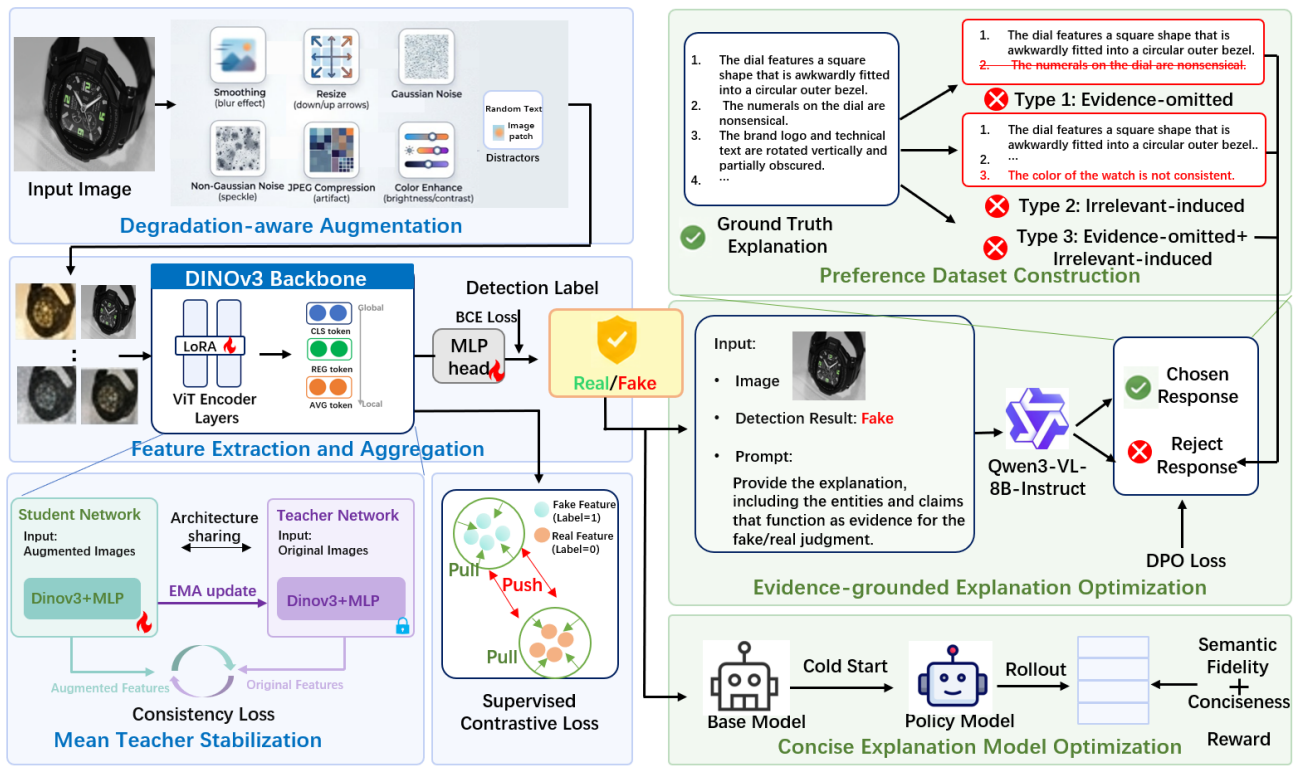
Exposes the model to diverse distortions, preventing intra-instance feature drift while preserving augmentation diversity.
Anchors augmented representations toward a stable feature reference, reinforced by supervised contrastive loss.
Constructs chosen-rejected explanation pairs to fine-tune the model to prioritize genuine manipulation evidence over superficial reasoning.
Optimizes concise explanations via Group Relative Policy Optimization with rewards on semantic fidelity and conciseness.
Results
We evaluate our framework on detection accuracy and explanation quality metrics, achieving state-of-the-art performance.
| Method | Accuracy |
|---|---|
| DINOv3 + MLP | 0.8823 |
| Ours | 0.9824 |
| Explain Model | SLEScore (norm/raw) | SimpleBert | SimpleOverall | ComplexBert | Entity F1 | Claim F1 |
|---|---|---|---|---|---|---|
| Baseline (Qwen3-VL-8B-Instruct) | 0.1037 / -0.4812 | 0.5775 | 0.4354 | 0.5038 | 0.4402 | 0.3362 |
| Ours | 0.9939 / 3.9699 | 0.6930 | 0.7783 | 0.7241 | 0.5969 | 0.5227 |
Results
We rank first among all participating teams on both the public leaderboard and the final hidden-test results of the ACM MM 2026 Explainable Deepfake Detection Challenge.

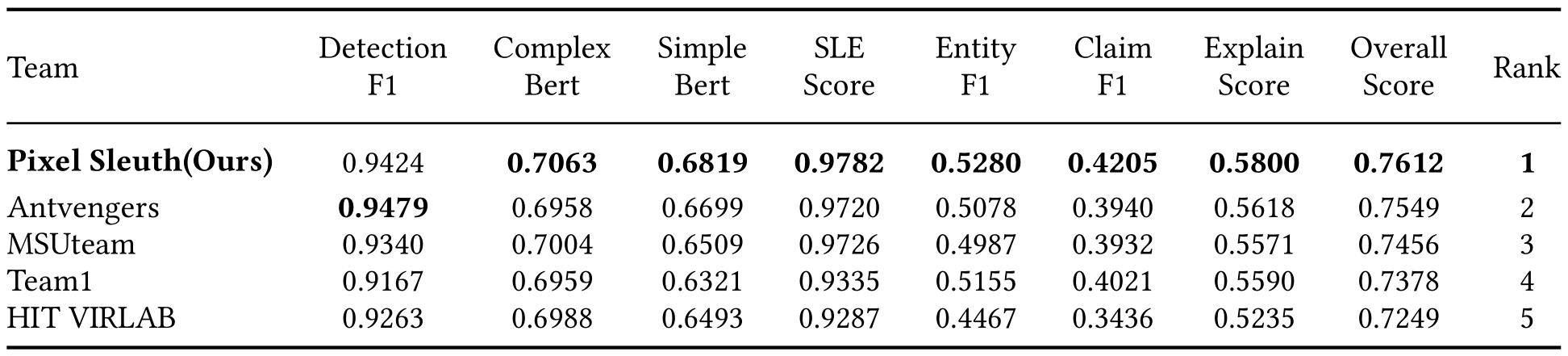
Pixel Sleuth, our team, ranks #1 on both the public leaderboard and the final hidden-test results.
Results
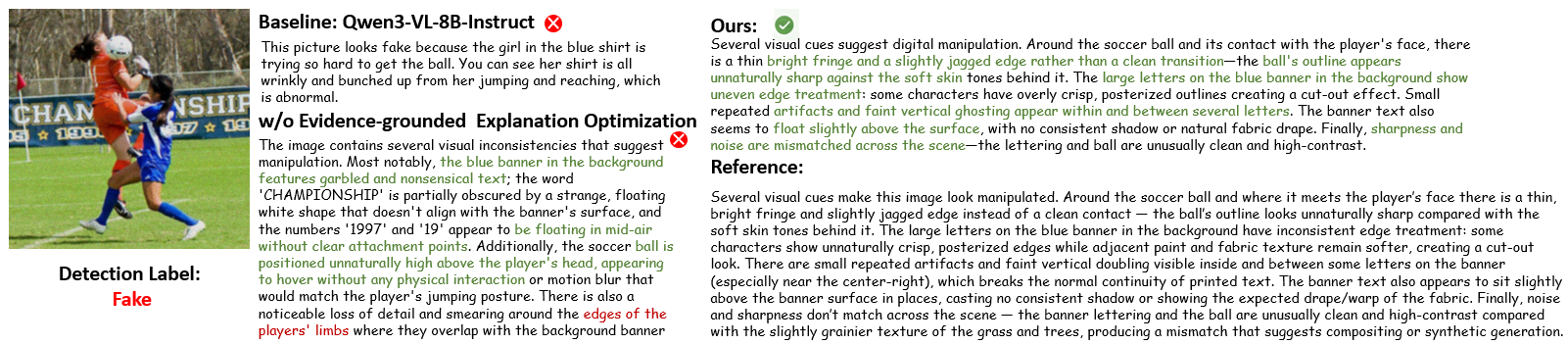
Visualizations for deepfake explanation. Baseline Qwen3-VL-8B-Instruct produces results with irrelevant information and fails to identify valid evidence. The SFT-only model captures partial evidence (marked in green) but still suffers from hallucinated irrelevant details (marked in red). Our model generates more complete and accurate explanation that identifies all manipulation traces (marked by green) without introducing spurious information.
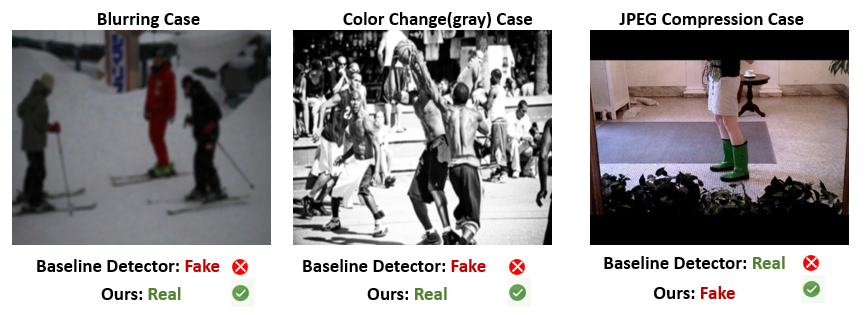
Qualitative comparison of detection robustness under samples with various image degradations. The baseline model misclassifies degraded samples, while our model shows correct predictions across different degradation types.
Acknowledgements
We thank the following projects: vLLM, ms-swift, XPlainVerse.
Citation
@inproceedings{xu2026edd,
  title     = {Explainable Deepfake Detection with Feature-robust Augmentation and Evidence-grounded Explanation Optimization},
  author    = {Xu, Zhu and Yang, Yunfan and Peng, Yuxin and Liu, Yang},
  booktitle = {ACM International Conference on Multimedia},
  year      = {2026}
}